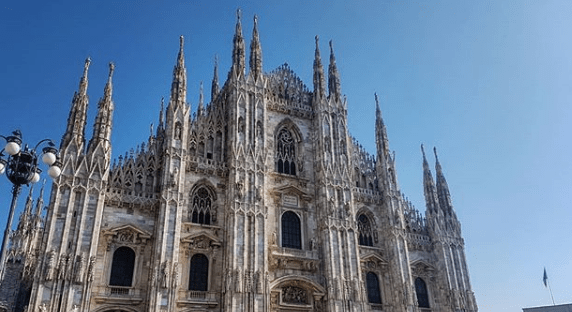
Today, we’re talking about my hometown, Milan.
Some people hate Milan and some people love it, and even if this is my city, I’m stuck in the middle.
We’re talking about things that I love today, the good side of the city, the side that people pay to see, but if you want to know something about the “bad side”, just leave a comment down below, I’d be happy to write about it.
So, if you’re planning to come to Milan, my advice is to avoid underground because you’ll miss a lot of the city, if you are tired or don’t want to walk, take a tram so you can still see the city!
Let’s start from the navigli. They were a system of navigable canals and they’re now one of the main places of Milan’s night life.
Even if they’re known for the night life, bars are opened all day so if you are around in the morning, you can stop in a bar and have a coffee or an icecream.
I always go there in the morning or in the afternoon because it’s quite but busy at the same time, it just gives me relax.
Then you can walk to the darsena which is the meeting point between two canals but also the beginning of porta ticinese, a street full of vintage shops, art gallery and temporary stores.
At the end of the street you’ll find the colonne di San Lorenzo, another place known fot the night life; It’s located in front of the Basilica di San Lorenzo, built in early christian style, is one of the oldest churches in Milan.
After that, you’ll get to via torino, just a street full of shops, but it will take directly to the Duomo, the cathedral church of the city, probably the most known monument of Milan; it is built in a gothic style and it’s covered by more than 3000 statues.
It is possible to get into the cathedral for free and you can go to the top of the Duomo by paying a ticket.
Next to the Duomo, there’s the Galleria Vittorio Emanuele II, designed and built by the architect Giuseppe Mengoni, it’s today one of the landmark of Milan. It’s mainly known for the luxury shops as Gucci or Prada.
This gallery connects the Duomo with the Scala Theatre, that has been rebuild due to a fire in 1776, today hosts the Accademia d’Arti e Mestieri dello Spettacolo (Academy for the Performing Arts).
Then, walking through Via Verdi, you’ll get to Via Brera, which hosts one of the most famous academy of fine arts.
Here you can see the Pinacoteca, a gallery with paintings like “The Kiss” by Francesco Hayez.
Near Brera, there is Via dei fori chiari, a beautiful alley full of typical restaurants and shops, that will bring you to Lanza, where you can see the Piccolo Teatro Strehler, a modern concert hall.
From the theatre you can see the Castello Sforzesco, another symbol of Milan. This castle was built in the 15th century by the Duke of Milan and today it hosts museums, art collections and also the famous “Pietà Rondanini” by Michelangelo.
Right outside the castle there’s a big park called Parco Sempione, which connects the castle to Arco della Pace, a triumphal arch built in a neoclassical style.
The area near this arch is full of locals and bars where is possible to have an aperitivo, typical in Milan!
This is where the itinerary ends, it shows the main monuments only because it’s made for a day trip, but if you want a three days (or more) itinerary in Milan, just let me know in the comments!
Alessia
 alessia's world